
For a long time I have put off writing my first post because I just did not know where to begin. However, with yesterday being Spinal Cord Injury Awareness day, I’ve found it has provided me with the perfect opportunity to spill some facts and pair them with my own experiences.
- More than 2.5 million people worldwide live with paralysis from a spinal cord injury (SCI), with around 50,000 people living with paralysis in the UK.
- Around 1000 people sustain an SCI each year in the UK and Ireland and every day, 3 people are told they will never walk again.
I remember, I wasn’t told the first day I awoke from my coma. It was like everybody was afraid to tell me. I couldn’t move anything below my arms, but it never even occurred to me that I was paralysed.
I knew I had had spinal surgery and that I had broken my neck and back, but I just assumed I couldn’t move because of an epidural or such like. I had so many tubes and wires sticking out of me, I put it down to medication. Also, to be perfectly honest, I barely thought about the fact I couldn’t move when I first woke up. Everything was so overwhelming and because I was only in pain above the level of my injury, I never really thought about what I couldn’t feel.
My broken back obviously had me in a lot of pain. It felt like I had been balancing all of my weight on my shoulder blades alone and all I needed was to go on my side to relieve the pressure. But, after being told by the Spanish doctors and nurses that I needed to keep still to allow my spine to heal, I remember laying in agony; knowing the pain would be worth it because my back would heal super quickly because I was being a good patient and I would be up and walking again in no time.
It was the next day that that notion of mine was destroyed and my life devastated. Being told you will never walk again is very surreal. I obviously cried… A lot. I mean, I was distraught. Life as I knew it would never be the same. I had gone on a sports holiday with my cheerleading team, gone onto my hotel room balcony and woke up nearly three weeks later a paraplegic.
To make a long story short, being told you will never walk again is an extremely difficult, soul destroying experienced not just for you, but also for those who love you.
- SCIs primarily affect young people and approximately 80% of those living with paralysis are male.
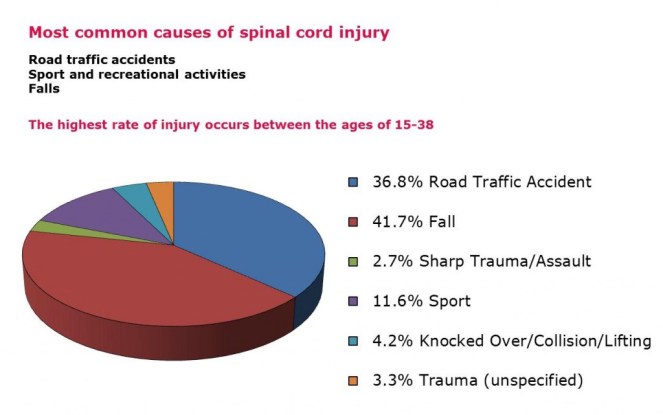
During my time at Salisbury Spinal Unit, I met only a handful of other young people:
- 4 boys were involved in motorcycle accidents
- 3 girls had car accidents
- 2 girls had motorcycle accidents
- 2 boys had sporting accidents (rugby/skiing)
- 2 girls (including myself) had falls – Interestingly, both whilst in Spain.
- An SCI is more than not being able to walk: it affects basic bodily functions such as loss of sensation, bladder control, bowel and sexual function, breathing difficulties and inability to control body temperature.
It is so much more than the inability to move. Unfortunately, a few years ago, a friend of mine from Canada whom I met at the world championships had an accident during training, broke his neck and suffered an SCI. I obviously sent him long, sad but encouraging messages at the time and as soon as he heard about my injury, he messaged me telling me he would help me through it and we now are in contact all the time.
I asked him how he went to the bathroom, as at that point, I was led flat in a hospital bed soiling myself, to then be cleaned up by the nurses. He told me that he went normally. I ignorantly then believed that he would wheel up to the toilet, hop on, do his business and then get back onto his chair and go merrily about his life.
I was wrong.
Typically, for myself and most others living with paralysis, going to the toilet is a PROCESS. I won’t go into too many details in this post, but these processes involve tubes and gloves and little pots of lube… I’m sure you can imagine what happens with those.
- 1/5 spinal injured patients are forced to live in care homes after they leave hospital.
They wanted me to move into a Leonard Cheshire Home because I was ‘bed blocking’ whilst in hospital. I hadn’t finished rehab, but they were finished with me and so they wanted to ship me off. They did ship me off to another hospital, whilst we waited for an adapted flat to become available because I simply refused to go into a nursing home at 21 years old.
Another patient I knew in the unit was sent to a nursing home, though. He broke his neck and could just wiggle one of his fingers enough to control an electric wheelchair. His family didn’t live close by and didn’t think they would be able to manage with him at home and so off he went. I’m passing no judgement at all because I can imagine the difficulty in making a decision like that. There are other factors involved like housing. In fact, that’s probably the biggest consideration and what causes a lot of patients to have to move into nursing homes. The whole situation is heart breaking.
- The cost to the nation is currently £1 billion per annum and is higher than those of comparable conditions such as dementia, multiple sclerosis and cerebral palsy.
There are the wheelchairs (which are just bicycle parts, but due to the need, obviously the price can be increased), medical equipment, prescriptions, carers and the routine medical procedures which are a cost to the NHS.
I, for example, have to have an operation every six months to inject Botox into my bladder. Because, clearly the answer to paralysis is more paralysis. My bladder, because of my SCI, spasms and empties when it feels like it and not just when it is full. I therefore wet myself all the time; at least every hour and a half, if not sooner. So, the Botox is used to paralyse and relax the muscle that is my bladder, so I can go to the bathroom every 4 or 5 hours, like a normal person. However, it’s been eight months and I’m still waiting for my repeat operation, but trust me, I will surely moan about that in another post. My mother doesn’t nickname me Lisa* for nothing.
*The Mona Lisa by Leonardo da Vinci… Get it? Ha
- There are currently no effective treatments for SCIs.
I went into hospital rehab believing that spinal rehabilitation meant getting me back up on my feet, walking, living life. No.
They teach you how to become functional with what you’ve got… Like anybody cares about that!
- They can affect anyone at anytime.
One moment you can be an independent, fun loving, do what you want when you want person and the next, you could need somebody to help wipe your arse and have transferring from your bed to a chair be classed as a great achievement…
For more information and ways to help/donate, here are some links to great SCI charities:
 The Woman in the Wheelchair